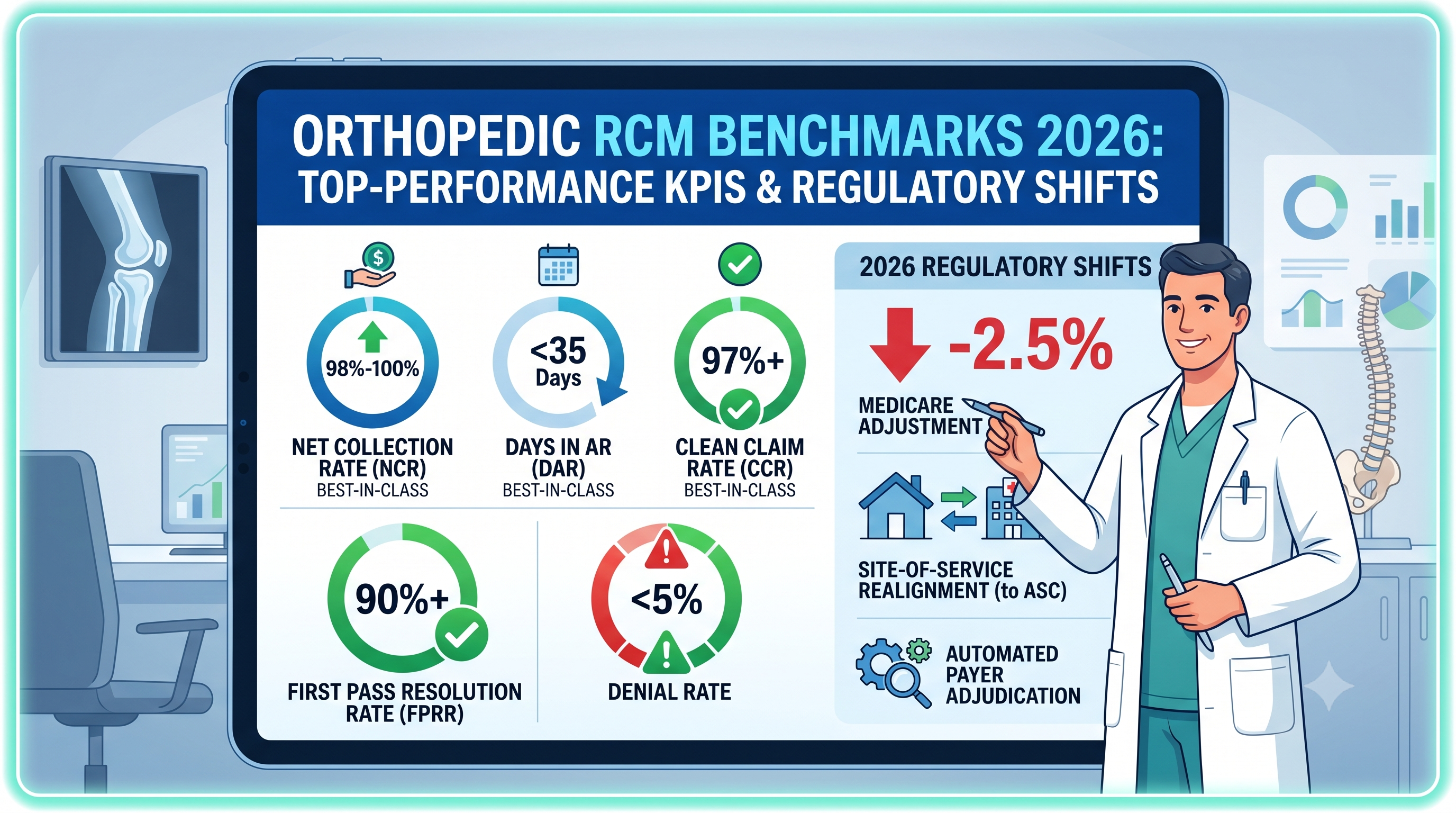
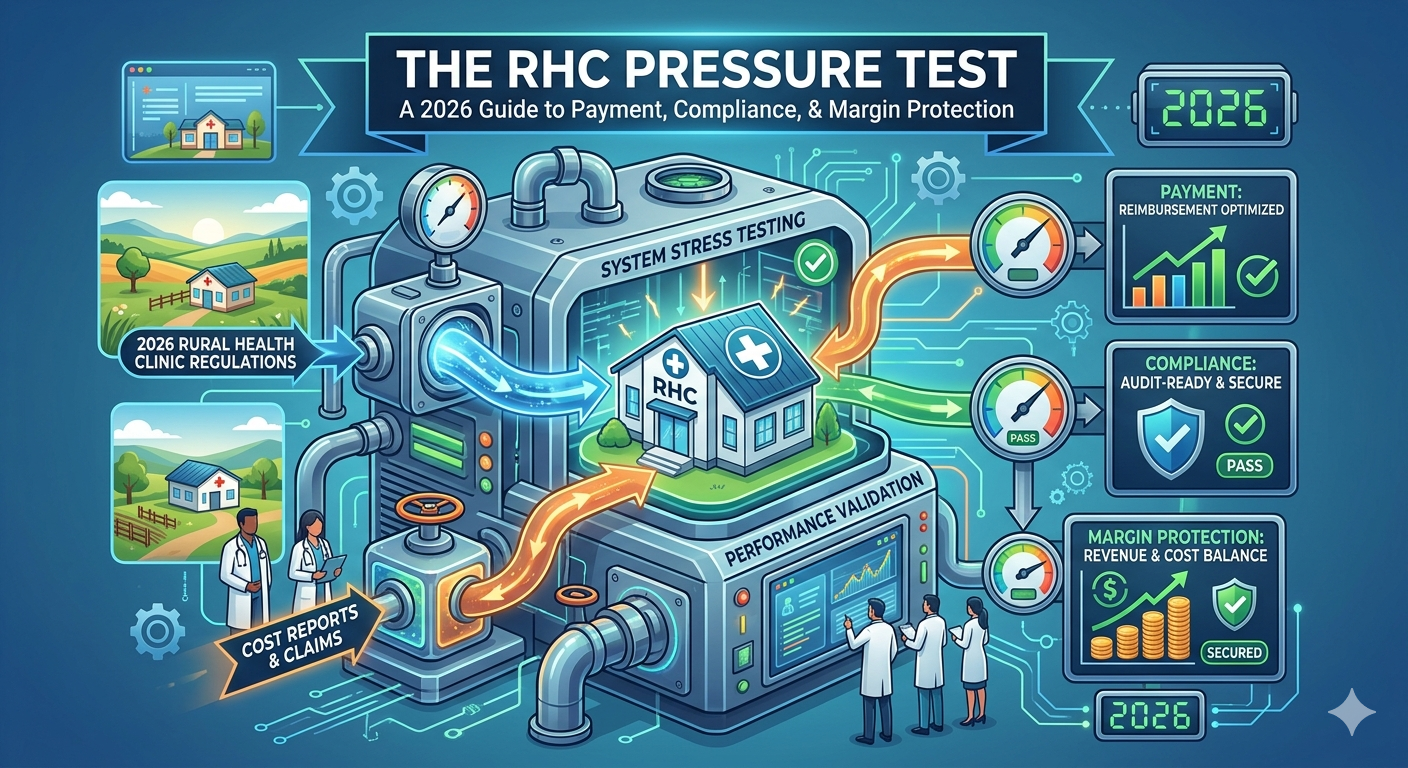
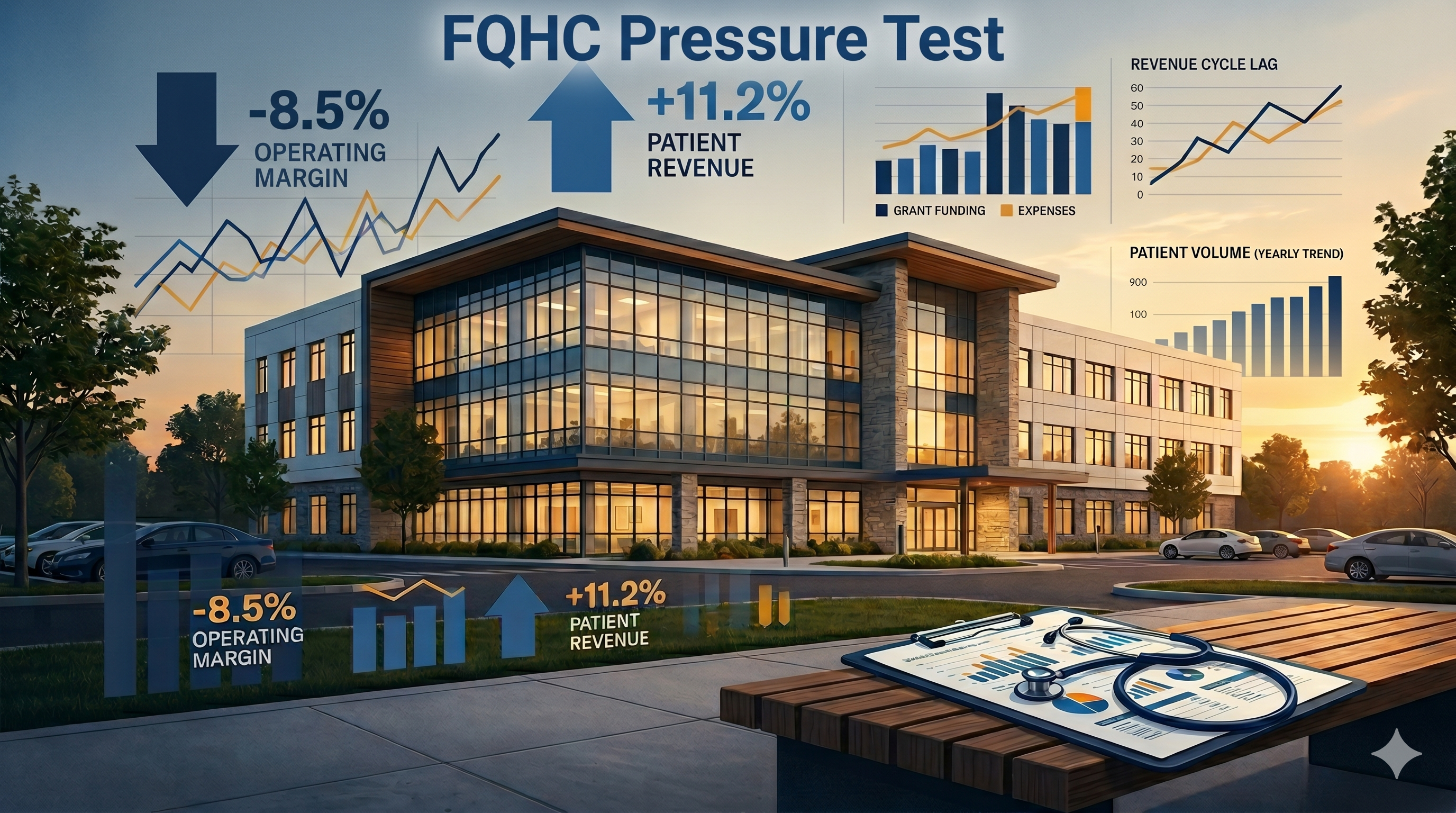
What independent medical practices, specialty groups, and physician organizations need to know from the largest health IT conference of the year — and what to do about it over the next 90 days.
Why HIMSS 2026 Mattered for Medical Practices
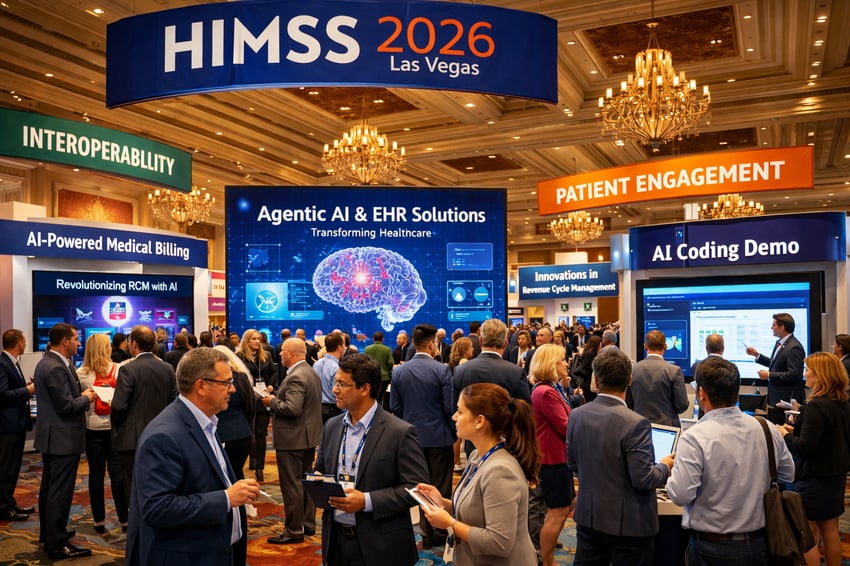
The 2026 HIMSS Global Health Conference & Exhibition brought more than 24,000 healthcare and technology leaders to the Venetian in Las Vegas from March 9–12, 2026, featuring 600+ educational sessions, 900+ exhibitors, and more than 800 expert speakers. Attendance skewed heavily to decision-makers: a significant portion of registrants came from the C-suite, and roughly three out of four were classified as decision-makers or influencers.
For hospital CIOs, that scale is routine. For independent practices, specialty groups, FQHCs, and physician organizations, HIMSS usually feels like a conference about someone else's problems. This year was different. The announcements out of Las Vegas fell squarely on the operational pressure points that define day-to-day profitability in a medical practice: prior authorization, denials, coding, scheduling, patient collections, and front-desk workload.
The single biggest story — repeated across the show floor, keynote sessions, vendor booths, and analyst recaps — is that agentic AI has moved from pitch deck to production. These are autonomous software agents that can reason, take multi-step action inside your existing systems, and complete work without a human driving every keystroke. In 2025, most of what practices heard about AI was clinical documentation. In 2026, AI is handling prior auths, writing appeal letters, coding encounters, answering patient questions, collecting balances, and filtering denials — and the outcome data is no longer hypothetical.
For medical practice leaders, HIMSS 2026 is a signal that the competitive cost structure of practice operations is shifting. For practices looking at the broader 2026 technology landscape, this recap pairs well with our companion guide on 18 technologies and strategies to drive medical practice revenue growth in 2026, which places these vendor announcements within a broader strategic framework. The practices that adopt early and deploy carefully will see measurable wins in net collections, days in A/R, staff capacity, and patient access. Those who wait will face both a widening technology gap and a narrowing labor pool.
This recap is built specifically for practice owners, administrators, RCM leaders, physicians, and clinical operations executives. It distills what happened, what matters, and what to do next.
Executive Summary: The Five Big Takeaways
1. Agentic AI is the new operating model for the revenue cycle. Waystar, FinThrive, XiFin, Solventum, Inovalon, Innovaccer, and nearly every major RCM vendor announced agentic AI capabilities that work prior authorizations, denials, appeals, and coding autonomously. Results cited include 90% reductions in time spent on appeal workflows, 42% reductions in prior auth turnaround, and meaningful underpayment recovery from agent-driven analyzers.
2. The EHRs themselves are becoming AI platforms. Epic previewed a no-code Agent Factory. eClinicalWorks introduced the AI API Workbench for practices that want to build their own agents. athenahealth launched athenaConnect and previewed a Model Context Protocol (MCP) server. ModMed, Greenway, Juno Health, Oracle Health, and Meditech all expanded AI capabilities within clinical workflows.
3. Interoperability is finally getting teeth. HHS and ONC confirmed the active enforcement of information-blocking rules for the first time since the 21st Century Cures Act. TEFCA has facilitated the exchange of more than 600 million health records across 75,000+ participating organizations. OIG is pursuing civil monetary penalties of up to $1 million per violation, and federal prior authorization APIs are required by January 1, 2027.
4. Patient access and the digital front door are being rebuilt on AI. From Amazon's Health AI agent to Talkdesk's Complex Scheduling tool to AI-native contact centers, the way patients find, book, and engage with a practice is being redesigned in real time.
5. Governance and measurement are now table stakes. With AI agents touching PHI, writing appeals, and influencing clinical decisions, a new category of AI governance vendors and agentic identity platforms emerged as a standalone market.
HIMSS 2026 by the Numbers
In This Article
Executive Summary: Five Big Takeaways
eClinicalWorks AI Workbench · ModMed Scribe · Epic Agent Factory · athenahealth MCP · Oracle Health · Greenway Novare · Waystar · FinThrive · XiFin · Innovaccer · Solventum · CoverMyMeds · RevSpring · Talkdesk · Heidi + R1 · Amazon Health AI · Dragon Copilot · Imprivata · Singulr AI · Codoxo · Vital Guard · LexisNexis
Seven Trends That Defined HIMSS 2026
RCM Implications: How the Revenue Cycle Is About to Change
What This Means for Independent Practices
Top Announcements and Demos from HIMSS 2026
Below are the announcements most relevant to medical practices, specialty groups, and physician organizations, with a brief assessment of where each one fits on the revenue cycle, patient care, or cost-reduction continuum — and how soon practices are likely to feel the impact.
1. eClinicalWorks AI API Workbench
Impact: RCM automation, cost reduction, staff capacity | Timeline: Near-term (0–12 months)
eCW debuted the AI API Workbench, a platform that enables small- and mid-sized practices to build and customize autonomous AI agents within eCW EHR workflows. CEO Girish Navani positioned the company's AI agents — including healow Genie and Sunoh.ai — as a "digital workforce" that handles paperwork, scheduling, and prior authorizations, allowing staff to focus on patients.
Why it matters: eCW is the dominant ambulatory EHR for free-standing physician practices. For Revele clients and the broader eCW community, this announcement means AI customization is no longer a capability reserved for enterprise health systems. Practices can now define their own agents against their own workflows — assuming they have the RCM and operational expertise to design them well.

2. ModMed Scribe Update
Impact: Clinical efficiency, documentation quality, coding accuracy | Timeline: Near-term (0–12 months)
ModMed updated ModMed Scribe to include note reconciliation and iPhone support, extending ambient documentation capabilities deeper into specialty workflows.
Why it matters: For specialty practices in dermatology, ophthalmology, orthopedics, ENT, GI, urology, and plastic surgery — ModMod's core markets — the scribe update expands documentation efficiency and brings it closer to the mobile point of care. Note reconciliation tightens the link between ambient capture and the structured data that drives coding, charge capture, and downstream reimbursement.
3. Epic Agent Factory and Three New AI Agents
Impact: Competitive dynamics across the EHR market; downstream RCM effects | Timeline: Medium-term (12–24 months)
Epic previewed its no-code Agent Factory, a visual builder that allows health systems to create and deploy custom AI agents inside the Epic environment. The company also introduced three named agents: Art (clinical documentation), Penny (billing and denial avoidance), and Emmie (patient scheduling and questions). Epic noted that more than 85% of its customers now use some form of Epic AI.
Why it matters: While Epic primarily serves larger systems, this matters for independent practices for two reasons. First, Epic sets expectations that spread across the market — if Epic has native coding and denial agents, every other EHR will be pressured to match. Second, many independent specialists work in referral relationships with Epic-based health systems, and the Agent Factory will change how those systems coordinate scheduling, referrals, and patient engagement with community practices.
4. athenahealth athenaConnect and MCP Server
Impact: Interoperability, AI ecosystem access, future-state RCM | Timeline: Medium-term (12–24 months)
athenahealth introduced athenaConnect, an intelligent interoperability layer that provides a single access point for external systems to connect with the approximately 170,000 providers on athenahealth, who collectively serve around 20% of the U.S. population. The company also previewed a Model Context Protocol (MCP) server that enables authorized AI agents to securely access patient data within athenaOne.
Why it matters: MCP is an emerging standard that allows AI agents to request information in natural language while maintaining governance and security controls. For practices, this is how external AI tools — scribes, RCM bots, patient engagement agents — will safely communicate with the EHR without custom integrations for each vendor. It is a foundational change to how the ambulatory software stack will be wired together over the next two to three years.
5. Oracle Health Clinical AI Agent
Impact: Clinical efficiency, competitive EHR dynamics | Timeline: Medium-term (12–24 months)
Oracle launched the Oracle Health Clinical AI Agent with documentation and next-step recommendations tuned to 30 specialties.
Why it matters: Specialty-specific AI documentation is becoming a baseline expectation. Practices evaluating EHRs — or negotiating renewal terms — should use Oracle's and Epic's investments as leverage points and should specifically ask their vendor about clinical AI roadmap milestones through 2027.
6. Greenway Health Launches Novare
Impact: RCM + clinical integration for ambulatory practices | Timeline: Near- to medium-term
Greenway launched Novare by Greenway Health, a clinical and RCM platform powered by agentic AI and built specifically for ambulatory care.
Why it matters: Novare is one of the first fully agentic AI platforms positioned explicitly for ambulatory practices rather than health systems. For multi-location physician organizations evaluating their next-generation EHR/RCM stack, Novare should be on the shortlist alongside athenaOne, eCW, and ModMed.
7. Waystar Autonomous Revenue Cycle Platform
Impact: Denial prevention, appeals automation, cash acceleration | Timeline: Near-term (0–12 months)
Waystar expanded its partnership with Google Cloud to accelerate agentic AI across its revenue cycle platform, integrating Gemini models and Google Cloud's data infrastructure. The company stated that since launching its AI platform, it has helped providers prevent more than $15 billion in denied claims, and clients have reported cutting time spent on appeal and documentation workflows by 90%. Waystar connects more than one million providers to every major payer through more than 100,000 live integrations.
Why it matters: The scale of Waystar's claims data is what makes its AI unusually predictive. Practices that work with Waystar (directly or through an RCM partner) are effectively buying access to industry-level denial-prevention intelligence. The 90% appeal workflow reduction is the number practice CFOs should be asking every RCM vendor about.
8. FinThrive Agentic AI Platform on Fusion
Impact: Underpayment recovery, denial reduction, cost to collect | Timeline: Near-term (0–12 months)
FinThrive unveiled an expanded agentic AI-powered revenue cycle platform built on its unified Fusion data architecture, with more than 50 AI and automation use cases across the revenue cycle. The company reported that its Denials and Underpayment Analyzer delivered a 1.1% recovery on overall underpayments — nearly $1 million in recovered cash within three months for early adopters.
Why it matters: The 1.1% underpayment recovery figure is the kind of specific, measurable outcome that makes AI credible at the CFO level. For practices running their own RCM, this is a benchmark to push internal analytics against. For practices outsourcing RCM, it is worth asking your vendor: what is our underpayment recovery rate, and how is agentic AI changing it?
9. XiFin Empower AI and the Appeals Agent
Impact: Appeals throughput, denial recovery, labor leverage | Timeline: Near-term (0–12 months)
XiFin unveiled Empower AI, an interoperable AI ecosystem for revenue cycle management that features an autonomous Appeals Agent capable of reviewing denied claims, retrieving medical-necessity documentation, drafting appeal letters, and submitting them to payers within defined compliance guardrails.
Why it matters: The autonomous appeals workflow is exactly the kind of high-volume, high-friction work that drains FTEs in billing offices. A practice that processes even 100 denials per month and currently writes each appeal manually is a candidate for this kind of tool — whether directly or through an outsourced RCM partner.
10. Innovaccer Flow Capture — Autonomous Coding
Impact: Coding efficiency, charge lag reduction, clean claim rate | Timeline: Near-term (0–12 months)
Innovaccer launched Flow Capture, an AI-powered solution that autonomously codes approximately 80% of encounters in seconds, targeting coder shortages, revenue leakage, and rising cost per encounter.
Why it matters: Autonomous coding is the single highest-leverage AI application for most medical practices. The constraint most practices feel is not coding accuracy — it is coder throughput. Tools that can code the bulk of routine encounters and escalate the complex cases materially shorten charge lag, reduce DNFB, and improve net collection rate. This category now has multiple credible players (Innovaccer, Solventum, eCW's AI for RCM, and others).
11. Solventum End-to-End Mid-Revenue Cycle Suite
Impact: Documentation quality, coding accuracy, denial prevention | Timeline: Near- to medium-term
Solventum highlighted its mid-revenue-cycle suite on AWS, combining ambient clinical documentation (Fluency Align), Autonomous Coding, and Revenue Integrity to prevent proactive denial.
Why it matters: Solventum's strategy demonstrates where the market is going: a single integrated workflow from the clinician's spoken note to the clean claim. Practices should expect vendors and RCM partners to compete increasingly on "mid-revenue cycle" as an integrated category.
12. CoverMyMeds Specialty Access and Affordability
Impact: Prior auth throughput, specialty therapy revenue, patient access | Timeline: Near-term (0–12 months)
CoverMyMeds expanded Specialty Access and Affordability Solutions to integrate benefits investigation, prior authorization, and enrollment directly into the EHR workflow, reducing administrative delays for complex specialty therapies.
Why it matters: Specialty practices that prescribe infused, injected, or biologic therapies lose both revenue and patient access due to friction from prior authorizations. Tools that collapse benefits investigation, PA, and patient enrollment into the EHR click path have direct revenue-protection value.
13. RevSpring Agentic Patient Financial Engagement
Impact: Patient collections, self-pay A/R, staff capacity | Timeline: Near-term (0–12 months)
RevSpring expanded its agentic AI capabilities for patient billing support, natural-language patient payments, and real-time staff guidance during financial conversations.
Why it matters: Patient responsibility is now the fastest-growing component of practice A/R and one of the hardest to collect. Self-service, natural-language patient payment tools — especially ones that work over SMS and voice — will outperform portal-only strategies. Practices should evaluate whether their patient payment vendor has roadmap credibility on agentic AI.

14. Talkdesk Complex Scheduling
Impact: Access, scheduling throughput, new patient revenue | Timeline: Near- to medium-term
Talkdesk debuted a Complex Scheduling tool using agentic AI to reduce specialty appointment delays and optimize physician capacity across contact centers and clinics.
Why it matters: Specialty scheduling — with multi-resource bookings, referral intake, insurance verification, and patient preference — is one of the most operationally painful problems in medical practice. Agentic scheduling tools are the first credible automation approach for this category.
15. Heidi + R1 Partnership
Impact: Documentation, coding accuracy, revenue capture | Timeline: Near- to medium-term
Ambient AI scribe Heidi announced a partnership with R1 to link care delivery and reimbursement processes.
Why it matters: The strategic signal: ambient scribes are moving from clinical-only tools to end-to-end documentation-to-reimbursement tools. Practices should increasingly evaluate scribes for coding impact, not just clinician time savings.
16. Amazon Health AI and Amazon Connect Health
Impact: Patient access, patient experience, competitive threat | Timeline: Medium-term (12–24 months)
Amazon launched Health AI, an agentic health assistant built on Amazon Bedrock and connected to nationwide health information exchanges. Eligible Prime members gain access to up to five free direct-message consultations. Amazon also released Amazon Connect Health as an AI-native contact center platform for healthcare.
Why it matters: Amazon is placing a consumer-grade health AI agent in front of more than 200 million Prime members. Practices should assume patients will increasingly arrive with pre-triaged questions, expectations of text-based communication, and consumer-grade digital experiences. The competitive floor on digital patient engagement just moved up.
17. Microsoft Dragon Copilot Expansion
Impact: Documentation, clinical decision support, expandable AI stack | Timeline: Near-term (0–12 months)
Microsoft expanded Dragon Copilot with role-based experiences for physicians, nurses, and radiologists, a new suite of AI partner apps spanning RCM to clinical decision support, and availability through Microsoft Marketplace.
Why it matters: Dragon Copilot has become one of the most widely deployed ambient documentation tools in U.S. healthcare. The partner app strategy means practices using Dragon can layer additional AI capabilities without adopting entirely new platforms. For specialty practices already invested in Dragon, this is a meaningful expansion of capability without disruption.
18. Imprivata Agentic Identity Management
Impact: Security, compliance, AI governance | Timeline: Medium-term
Imprivata launched agentic identity management that authenticates and controls AI agents using role-based permissions, short-lived authentication tokens, and real-time shutdown capabilities.
Why it matters: Every AI agent that touches PHI, writes in the chart, or initiates a transaction is a new security and compliance surface. Identity management for agents is a prerequisite for deploying them safely. Practices should ask their EHR and RCM vendors how AI agents are identified, authorized, and audited.
19. Singulr AI Agent Pulse
Impact: Compliance, risk management, AI governance | Timeline: Medium-term
Singulr AI launched Agent Pulse, a runtime governance platform that monitors AI agent behavior in real time, with context discovery, risk intelligence, and policy enforcement.
Why it matters: AI governance is emerging as a distinct category. For multi-location groups and larger practices, the question of "how do we know our agents are behaving" will become a compliance obligation. Practices should start building an AI oversight framework now — even internally, before a vendor requires it.
20. Codoxo AI Fraud Detection
Impact: Documentation integrity, audit defense, denial risk | Timeline: Medium-term
Codoxo introduced AI-driven fraud detection technology designed to detect synthetic medical documentation.
Why it matters: As AI-generated documentation becomes widespread, so do AI-generated fraudulent claims. Payers are adopting detection tools like Codoxo, which means practices need to ensure their documentation is supported by genuine, attributable clinical work. Ambient scribes are safe; hallucinations are not. Documentation integrity has always mattered, but the stakes just went up.
21. Vital Guard
Impact: Patient safety, malpractice risk reduction, downstream revenue | Timeline: Medium-term
Vital debuted Vital Guard, an AI solution that reviews clinical documentation and radiology reports to flag incidental findings that were not communicated, then closes the loop with auditable, asynchronous patient outreach.
Why it matters: Incidental findings are both a malpractice exposure and a missed-revenue issue. Closing that loop — automatically, with documentation — protects the practice and often generates appropriate downstream encounters. This is AI that improves both patient safety and practice economics simultaneously.
22. LexisNexis Deepfake and Fraud Defense for MyChart
Impact: Security, compliance, patient trust | Timeline: Medium-term
LexisNexis expanded Epic MyChart security with deepfake and fraud defense capabilities.
Why it matters: Identity fraud in healthcare is accelerating, and patient portals are a known attack surface. For practices that rely on portal-based workflows, expect identity verification to become a larger part of patient access over the next 12–24 months.
Seven Trends That Defined HIMSS 2026
Trend 1: Agentic AI Is the New RCM Operating Model
The word "agentic" was everywhere — but unlike prior years, it was paired with outcome data. Waystar cited $15B in prevented denials and 90% reductions in appeal workflow time. FinThrive cited 1.1% underpayment recovery worth nearly $1M in three months. Prior authorization turnaround times were down 42% at multiple booths. The conversation is no longer "will AI work in the revenue cycle?" — it is "how fast can we deploy it, and how do we govern it?"
What it means for practice leaders: If your RCM vendor or internal team cannot articulate an agentic AI roadmap with measurable targets for 2026 and 2027, that is a strategic gap. Expect aggressive margin pressure on RCM pricing over the next 24 months as AI reduces the cost to collect.
Trend 2: EHRs Are Becoming AI Platforms, Not Just Documentation Systems
Epic's Agent Factory, eCW's AI API Workbench, and athenahealth's MCP server all point in the same direction: the EHR is becoming the platform on which a portfolio of AI agents runs. Greenway's Novare and Juno Health's Version 25 both position AI as a native layer rather than a bolt-on.
What it means for practice leaders: EHR switching conversations will increasingly be AI-capability conversations. Practices should include AI roadmap evaluation in every EHR RFP and renewal negotiation — and ask specifically about coding, prior auth, denials, and patient engagement agents, not just documentation.
Trend 3: Interoperability Enforcement Is Finally Real
HHS and ONC confirmed active enforcement of information blocking rules, with product decertification now an explicit consequence. TEFCA has exchanged more than 600 million documents across 75,000 connections. More than 1,500 formal information blocking complaints have been filed. OIG is pursuing civil monetary penalties up to $1 million per violation. CMS-0057-F requires FHIR-based prior authorization APIs by January 1, 2027.
What it means for practice leaders: Interoperability has moved from "nice to have" to "compliance infrastructure." Practices should verify their EHR is certified under current ONC standards and confirm their payer mix is on track with CMS-0057-F timelines.
Trend 4: Patient Access Is Being Rebuilt on Agentic AI
From Amazon Health AI's consumer footprint, to Talkdesk Complex Scheduling, to AI-native contact centers, the end-to-end patient access workflow is being rebuilt around conversational AI. Kiosk and self-service vendors emphasized accessibility compliance ahead of the HHS Section 504 deadlines, which mandate adherence by May 11, 2026, for larger entities.
What it means for practice leaders: The competitive floor on patient access has risen. Patients increasingly expect 24/7 self-service booking, two-way text communication, and personalized reminders. Practices that rely on phone-based access alone will lose patients to systems that make booking as easy as Amazon.
Trend 5: Governance, Identity, and Measurement Became a Real Category
HIMSS 2026 was the year AI governance became a discrete vendor category. Singulr AI, Imprivata, and Codoxo all launched products to control, authenticate, and audit AI agents that handle PHI.
What it means for practice leaders: Every practice that deploys AI agents — its own or its vendors' — will need an answer to "who is accountable when the agent is wrong?" Practices should begin building an internal AI inventory and oversight process in 2026, even if lightweight.
Trend 6: Specialty-Specific AI Is the Next Frontier
Oracle shipped a clinical AI agent tuned to 30 specialties. ModMed expanded its specialty scribe. CoverMyMeds focused on specialty therapy workflows. The generic AI scribe is becoming specialty-specific, and that specialty context shows up in coding, templates, orders, documentation, and downstream reimbursement.
What it means for practice leaders: Specialty practices should not accept general-purpose AI tools as sufficient. Ask vendors what specialty-specific training data, templates, and decision support they offer. The practices that deploy specialty-tuned AI will have both better documentation and better charge capture.
Trend 7: Cost Pressure Is the Unifying Driver
Underlying every conversation at HIMSS 2026 was an unavoidable truth: healthcare spending could rise from roughly 17% of GDP today to nearly 30% by 2050. Industry leaders consistently framed AI, interoperability, and data liquidity as economic imperatives rather than nice-to-haves.
What it means for practice leaders: Expect payers, CMS, and employers to increase pressure on unit cost and administrative overhead throughout 2026 and 2027. The practices that automate aggressively will absorb that pressure with less disruption to staff and physician comp than those that wait.
RCM Implications: How the Revenue Cycle Is About to Change
If you run the finance, billing, or RCM function at a medical practice, this is the most important section of this recap. The revenue cycle is about to change faster than it has in the past 20 years, and the changes will be uneven.
| Timeframe | Workflow | Key Signal |
|---|---|---|
| 0–12 months | Eligibility & benefits verification | Eligibility-driven scheduling is becoming standard |
| Prior authorization | 42% turnaround reduction; CMS-0057-F APIs by Jan 2027 | |
| Autonomous coding | 80% of encounters coded in seconds (Innovaccer) | |
| Denial management & appeals | 90% appeal workflow reduction (Waystar) | |
| Patient payment engagement | Conversational, omnichannel, self-service replaces portal-only | |
| 12–24 months | Agentic scheduling & access | Talkdesk, Amazon Connect Health, AI contact centers |
| Documentation-to-claim workflows | Heidi+R1, Solventum, Dragon Copilot RCM apps | |
| Specialty-specific coding & CDI | Oracle 30-specialty AI; ModMed specialty expansion | |
| 24+ months | Full autonomous revenue cycle | Requires unified data, governance, payer interop |
| MCP-based agent ecosystems | athenahealth MCP is the early signal; still nascent |
The Patient Financial Experience Is the Swing Factor
One theme unified every RCM announcement at HIMSS 2026: the patient financial experience is now the biggest unsolved problem in the revenue cycle. Eligibility, coding, claim submission, and denial management are all increasingly automatable. Collecting accurate, timely, complete payment from patients — particularly under high-deductible plans — is not. Practices that invest in self-service estimation, text-first payment workflows, and conversational patient financial engagement will outperform those that hold on to paper statements and call-center collections.
What This Means for Independent Practices
Independent practices, specialty groups, FQHCs, CHCs, RHCs, and small- to mid-sized multi-location physician organizations have a narrower window and more constraints than large health systems. A few specific takeaways:
You do not have to build AI. You do have to buy it wisely. Most practices lack the IT capacity to build autonomous agents. The right strategy is to ensure your EHR and RCM partners have credible AI roadmaps and to demand measurable outcomes in contracts.
RCM outsourcing partners are becoming AI infrastructure partners. Evaluate your RCM vendor on what AI they are deploying on your behalf — underpayment recovery rate, denial reduction, coding accuracy, patient collection performance — not just their fee percentage.
Interoperability compliance is not optional. CMS-0057-F, information blocking enforcement, and TEFCA expansion all apply whether you are large or small. Make sure your EHR and clearinghouse are up to date.
Patient access is a competitive battleground. Amazon, One Medical, and consumer-first digital health are setting expectations that your patients will bring to your front desk. Invest in two-way text, online scheduling, and self-service payment.
Specialty practices should expect specialty-specific AI. If your EHR cannot articulate specialty AI capabilities for your service lines, that is a renewal-cycle conversation.For a deeper dive into how these specialty AI tools fit alongside other 2026 revenue strategies — including new RPM CPT codes (99445, 99470), APCM codes (G0556, G0557, G0558), and AI-assisted diagnostic billing under CPT 75577 — see our companion article on 18 technologies and strategies for medical practice revenue growth.
What to Watch Next
Several follow-on developments are highly likely in the next 6–18 months:
MCP adoption by additional EHRs. Expect eCW, ModMed, Greenway, and others to announce MCP or MCP-like interfaces over the next 12 months, creating a broader ecosystem for third-party AI agents.
CMS-0057-F FHIR prior auth API rollout. January 1, 2027, is the compliance date. Expect large payers to turn on APIs in 2026, with usable practice-facing tooling following shortly after.
AI governance is becoming a vendor requirement. Expect CIOs and compliance leaders to begin requiring vendor attestations about agent identity, authorization, and audit capability in 2026 and 2027 RFPs.
Consolidation in ambient documentation. Ambient scribes (Abridge, Heidi, Nuance/Dragon, Suki, ModMed Scribe) are the most competitive category of AI in healthcare. Expect consolidation and platform partnerships through 2027.
Measurable pricing pressure on traditional RCM. As AI reduces the cost to collect, expect RCM pricing models to shift — with more practices negotiating outcomes-based, performance-linked pricing.
Vendors and Solution Categories Worth Evaluating in the Next 90 Days
| Category | Vendors to Evaluate |
|---|---|
| Ambulatory RCM & denial management | Waystar, FinThrive, XiFin, Solventum, Inovalon, eCW AI, Revele |
| Autonomous coding & CDI | Innovaccer Flow Capture, Solventum, eCW AI, ModMed |
| Prior authorization automation | CoverMyMeds, Waystar, athenahealth, specialty-specific vendors |
| Patient access & digital front door | Amazon Connect Health, Talkdesk, athenahealth, ModMed, eCW healow Genie |
| Patient financial engagement | Revele Pay, RevSpring, integrated EHR payment modules |
| Ambient documentation (with RCM linkage) | Microsoft Dragon Copilot, Abridge, Heidi+R1, ModMed Scribe, Oracle Health |
| AI governance & identity | Imprivata, Singulr AI Agent Pulse, Codoxo |
Leadership Takeaways: What to Do in the Next 90 Days
HIMSS 2026 will not change your practice overnight. But the leaders who move deliberately in the next 90 days will be measurably ahead by year-end.
1. Audit your current RCM stack against the HIMSS 2026 capability set. List every RCM system, tool, and outsourced partner. For each, ask: what agentic AI capabilities do they have deployed or on the 2026–2027 roadmap? What outcome metrics can they show you — underpayment recovery, denial reduction, clean claim rate, days in A/R, cost to collect? This audit will tell you where you have gaps.
2. Set outcome-based targets for 2026. Translate what you heard from HIMSS into specific targets: denial rate, first-pass clean claim rate, prior auth turnaround, underpayment recovery, patient payment yield, and days in A/R. Use the vendor-cited outcomes (90% appeal workflow reduction, 42% prior auth reduction, 1.1% underpayment recovery, 80% autonomous coding) as benchmarks, not ceilings.
3. Verify interoperability and regulatory readiness. Confirm your EHR certification status, your payer connectivity roadmap for CMS-0057-F, and your exposure to information blocking complaints. If you are an FQHC, CHC, or RHC, add TEFCA readiness and grant-funded IT modernization pathways to that list.
4. Pilot one agentic AI workflow with a clear ROI thesis. Pick one workflow — autonomous appeals, PA automation, patient payment outreach, or autonomous coding on a limited service line — and run a 60- to 90-day pilot with measurable baseline and target. Treat this as learning, not commitment.
5. Start the AI governance conversation now. Even if your practice has only one or two AI tools today, stand up a simple internal process: an inventory of AI tools touching PHI or financial data, a designated owner, and a quarterly review. This is cheap now and expensive later.

Final Thought
HIMSS 2026 was the conference where the AI conversation shifted from "can it work?" to "how do we deploy it responsibly?" For medical practice leaders, that shift is a gift. It means the technology is finally mature enough to create real operational and financial value, and the market has produced enough vendor options that you can evaluate and choose without betting on a single untested approach.
The practices that win in 2026 and 2027 will not be the ones with the biggest IT budgets. They will be the ones with the clearest priorities, the most disciplined RCM operating model, and the best partners. That combination has always been the formula for high-performing medical practices. What HIMSS 2026 made clear is that the tools to execute on it have changed dramatically — and the gap between early adopters and laggards is about to widen.
Ready to Translate HIMSS 2026 into RCM Performance?
For practices using eClinicalWorks, Epic, ModMed, Allscripts, or other ambulatory EHRs that want help translating HIMSS 2026 developments into specific RCM performance improvements, Revele's team of RCM consultants and AI automation specialists can help. Revele has recently unlocked its acclaimed RISE Program to all medical practices.